This is the full 2026 guide to which kind of compression actually works for Restless Legs Syndrome. You will see what the studies say, what each type costs in time and money, and how to know whether the option you are considering is worth a single more dollar of your attention.

The short answer: yes, but not the compression you are picturing
Most people, when they hear “compression for Restless Legs,” think of the graduated compression socks pharmacies sell for varicose veins or long flights. Those are not the type with research support for Restless Legs Syndrome.
The compression that does have research support is different. It is targeted, applied to a specific part of the foot, worn overnight, and built to a much lower, more even pressure than the medical-grade circulatory socks. In one head-to-head trial against a standard Restless Legs medication, this kind of targeted foot compression outperformed the drug by a meaningful margin. We will get into the numbers below.
If you only take one thing from this article: the question is not “does compression work for restless legs,” it is “which kind of compression, and how is it worn.” That distinction is the difference between forty-five dollars wasted and a quiet night.
The three types of compression people try, and what the evidence says
Three categories show up in the Restless Legs conversation. Only one has solid trial data.
Compression socks (the kind from the chemist)
These are the graduated knee-high socks designed for venous insufficiency, varicose veins, swelling during pregnancy, and flight-related clotting prevention. They squeeze hardest at the ankle and ease off as they go up the leg, helping push blood back toward the heart.
Do compression socks help restless legs? Honestly, the evidence is thin. Most of the support is anecdotal: people who wear them all day for unrelated reasons report their legs feel a bit quieter at night. There are no large, double-blinded trials showing graduated medical socks specifically treat Restless Legs Syndrome. The mechanism (circulatory return) does not match the dopamine-driven sensorimotor pattern that drives Restless Legs symptoms.
If you already wear compression socks for varicose veins and they take the edge off, keep wearing them. If you are buying a pair specifically for Restless Legs, you are gambling on weak evidence with a product designed for a different problem.
Pneumatic compression devices (PCDs)
This is the next step up: an inflatable wrap connected to a pump, which cycles air through the wrap to apply rhythmic pressure to the legs. Hospitals use them after surgery to prevent clots. A smaller body of research has tested them specifically for Restless Legs Syndrome.
Lettieri and Eliasson published a randomised, double-blinded, sham-controlled trial in CHEST in 2009. Participants used a pneumatic compression device (the Aircast VenaFlow) at either therapeutic or sham (sub-therapeutic) pressure. The therapeutic group saw real symptom improvement: Restless Legs Severity Score dropped from 14.1 to 8.4, Johns Hopkins Restless Legs Scale improved from 2.2 to 1.2, and one in three subjects reported complete relief. None of the sham subjects achieved complete relief.
This is genuine evidence that pneumatic compression helps. The catch: the device is bulky, plugged into a wall, and used for an hour or so before bed, not all night. It is more like a medical appliance than a sleep product. If you are willing to do a daily one-hour session with a machine that looks like it belongs in a hospital, this is a real option. Most women looking for a quiet night while they sleep want something simpler.
Targeted overnight compression
This is the third category, and the one with the strongest clinical match to the way Restless Legs symptoms actually behave. It is light, steady, evenly applied pressure to a specific part of the foot, worn through the night, with no pump, no batteries, no electronics. The pressure is designed to settle the nervous-system signal that drives the urge to move before that signal builds.
Kuhn and colleagues published the relevant trial in the Journal of the American Osteopathic Association in 2016. They compared targeted foot compression against ropinirole (the dopamine agonist sold as Adartrel in Australia) in 30 adults with moderate-to-severe primary Restless Legs Syndrome, over eight weeks. On the Clinical Global Impression scale, the compression group recorded a 90 per cent improvement. The ropinirole group recorded 63 per cent. Compression came out 1.4 times more effective than the prescription drug.
This is the strongest piece of non-drug clinical evidence in the Restless Legs field. Targeted overnight compression is also the category Stillr was built for. It is a wearable, sleep-friendly version of the same mechanism, in a softer form than the original clinical wrap, in two sizes that fit most adult feet.
Why targeted overnight compression has the strongest data
A reasonable question: why does compression worn on a small part of the foot beat a medication that floods the whole brain with dopamine? Two reasons sit at the centre of the current research.
First, Restless Legs Syndrome is increasingly understood as a sensorimotor disorder with a peripheral input the brain misreads as an urge to move. Targeted pressure on the area research shows responds appears to interrupt that input before it climbs. The drug works downstream by pushing on dopamine; the compression works upstream by changing the signal in the first place.
Second, dopamine agonists like ropinirole and pramipexole carry a long-term risk called augmentation: a gradual worsening of the very symptoms they were prescribed to settle. The 2024 American Academy of Sleep Medicine (AASM) clinical practice guideline now suggests against routine use of both drugs because of this. Compression carries no equivalent long-term penalty. You can wear it for years without the body learning to need more of it.
That combination, a stronger short-term effect plus no augmentation risk, is what makes targeted overnight compression the headline option in any honest answer to “does compression work for restless legs.”
When compression alone is not enough
This is the part of the conversation that builds trust. For many women, targeted overnight compression alone is enough to take Restless Legs symptoms from disrupting sleep to background noise. For others, it is one layer of a bigger drug-free plan. That plan usually includes four other moves. A serum ferritin test, where the 2024 AASM guideline now strongly recommends intravenous iron correction for adults with ferritin under 100 micrograms per litre. Cutting caffeine and alcohol in the second half of the day. A short evening walk. And a sensible bedtime routine that does not involve scrolling until midnight.
The order that works for most women: get the ferritin number first, audit caffeine and alcohol second, add overnight compression third, layer in stretching or magnesium last. Compression sits where it sits in the sequence because it is the highest-impact step that does not require a doctor visit or a fortnight of withdrawal. For the full 11-method version of the sequence, see how to stop Restless Legs at night, sorted by effort to impact.
For a smaller group, especially those with severe Restless Legs, no non-drug option will be enough on its own. The 2024 AASM guideline now points those women toward the alpha-2-delta ligand class of medications (gabapentin enacarbil, gabapentin, pregabalin) rather than the older dopamine agonists. This conversation belongs with your GP. Compression does not replace the medical relationship; it gives you a tool that the relationship can work around.
What to look for in a compression product for Restless Legs
If you are shopping, here are the criteria that matter, drawn from how the published research actually delivered the results.
- Targeted, not whole-leg. The strong evidence sits with pressure applied to a specific area of the foot, not a sock that compresses the whole calf.
- Worn overnight, not for a one-hour session. The benefit shows up during sleep, when symptoms peak. Daytime-only devices miss the window.
- Steady, even pressure, not a tight squeeze. The clinical wrap in the Kuhn trial used a controlled, low-grade pressure. Tight squeezing is uncomfortable and is not what worked in the trial.
- No electronics. Anything with a battery, pump, or remote control will eventually break or be abandoned.
- Sized properly. A device that slides off mid-night will not deliver the pressure the trial used.
- A trial period. Restless Legs is individual. The right product is the one your body responds to, and you cannot know until you have slept a few nights in it. A real 30-night sleep trial with full refund is the floor.
Most products in the Australian market fail at least three of these. That is the gap Stillr was built to close.
What the research actually shows
Two trials carry most of the weight in the compression-for-Restless-Legs conversation, supported by the current AASM guideline.
Kuhn et al. (2016), Journal of the American Osteopathic Association. Eight-week head-to-head trial, 30 adults, moderate-to-severe primary Restless Legs Syndrome. Targeted foot compression versus ropinirole. Compression produced 90 per cent improvement on Clinical Global Impression; ropinirole produced 63 per cent. Compression was 1.4 times more effective than the drug.
Lettieri and Eliasson (2009), CHEST. Randomised, double-blinded, sham-controlled trial of a pneumatic compression device. Therapeutic-pressure group: Restless Legs Severity Score improved from 14.1 to 8.4, Johns Hopkins Restless Legs Scale from 2.2 to 1.2, complete relief in one third of subjects. None of the sham-pressure subjects reported complete relief.
AASM clinical practice guideline (2024). Conditional-against recommendations for pramipexole and ropinirole due to augmentation risk. Strong recommendations for alpha-2-delta ligand calcium channel blockers and for intravenous ferric carboxymaltose in adults with ferritin under 100 micrograms per litre.
What the literature does not yet show: strong head-to-head data between targeted overnight compression and pneumatic compression devices. Both work; the practical difference is whether you want to wear something to sleep or sit with a machine for an hour before bed.
What Stillr is, and isn’t
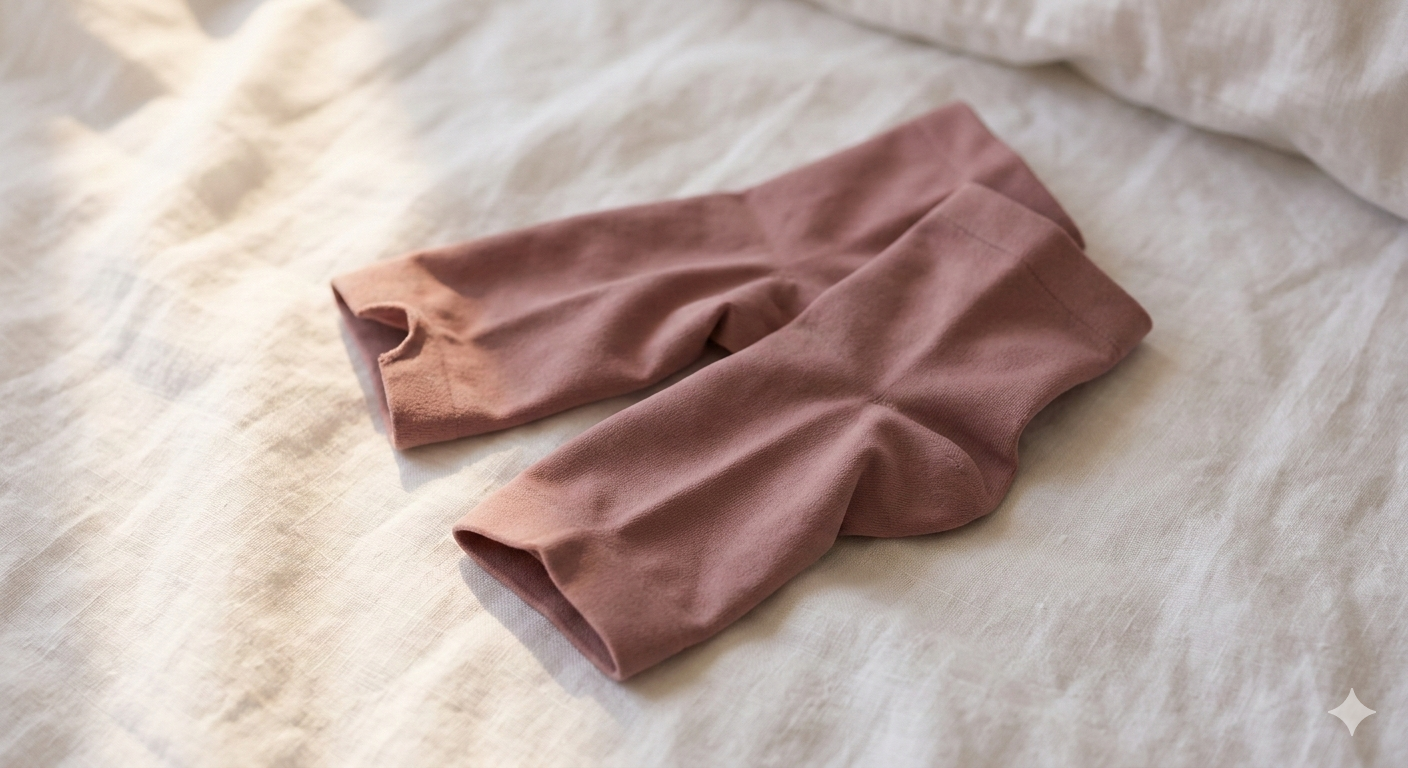
Stillr is a drug-free overnight compression sleeve, worn on both legs, built around the targeted-pressure mechanism behind the strongest non-drug evidence for Restless Legs Syndrome. It is unisex, sized for adult feet, and currently pre-launch in Australia. Every pair comes with a 30-Night Sleep Trial, full refund if it does not improve your sleep. Reserve your pair on the founders’ list at stillr.com.au, where current pricing and sizing are listed.
Stillr is not a medication, not a cure, not a treatment for any disease. It is a wellness product, built around what the research suggests the body responds to.
If “drug-free, on my own terms” sounds like the version of this you want, join the founders’ list at stillr.com.au. We will tell you the moment your size opens.