This is the full guide to drug-free restless legs treatment: what the research supports, what the new 2024 American Academy of Sleep Medicine guideline changed, what to try in what order, and what to skip. No miracle cures, no pricey gadgets you will never use, no scripts you have to argue your GP into. If you have spent any time on forums looking for restless legs without medication, you have probably read a hundred conflicting tips. This guide sorts them.
Why drug-free restless legs treatment matters more in 2026
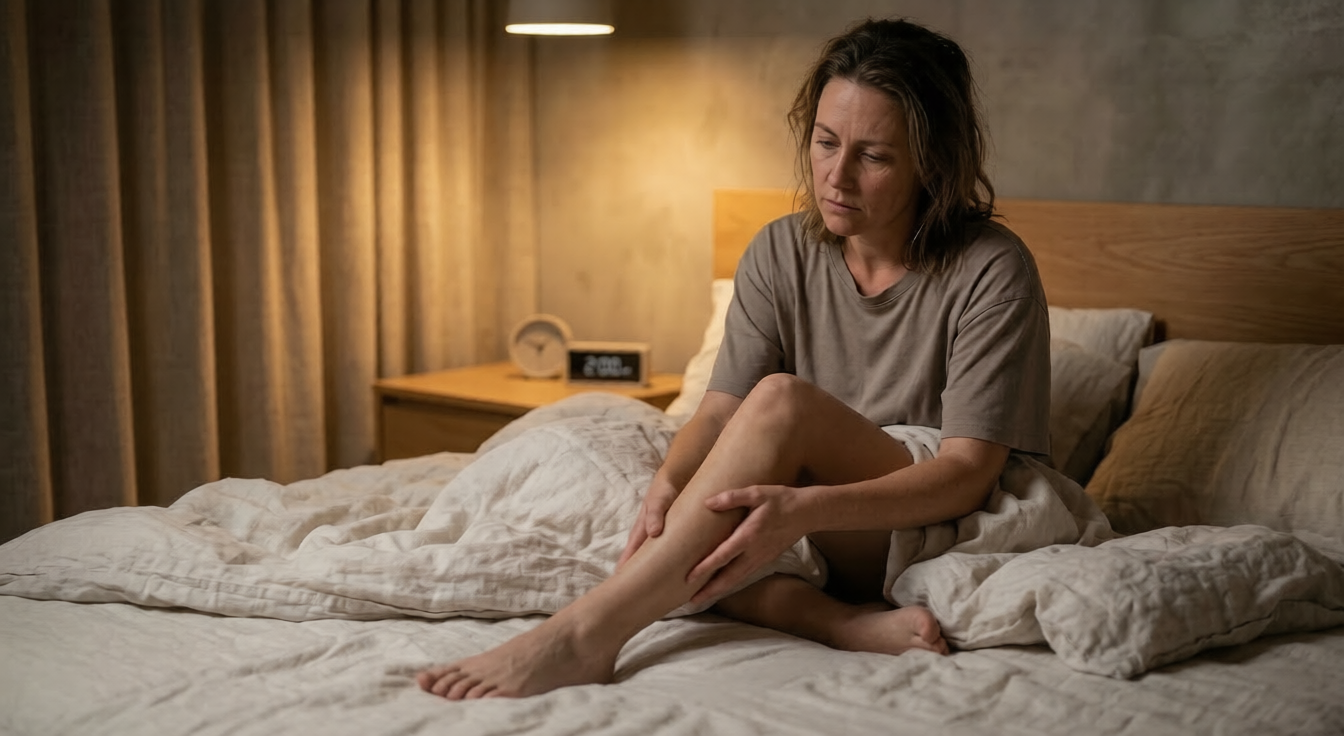
Most women who land here are already half-decided. Maybe Sifrol kept the legs quiet for a year and then made everything worse around 2am. Maybe ropinirole gave you a kind of nausea that made the legs feel like the easier problem. Maybe a friend has just been put on gabapentin and you would rather not start that conversation with your own GP. Maybe you have not started any medication yet, and you would prefer not to. (If your symptoms got louder around perimenopause, the hormone connection between Restless Legs and menopause is worth a separate read.)
The science has moved with you. In September 2024, the American Academy of Sleep Medicine (AASM) released a major update to its clinical practice guideline for Restless Legs Syndrome. The headline change: the AASM now suggests against the routine, ongoing use of pramipexole (sold as Sifrol in Australia) and ropinirole as standard treatment. Both were first-line for years. Both are now conditional recommendations, with moderate certainty of evidence, because long-term use carries a real risk of augmentation, the gradual worsening of the very symptoms the drug was meant to settle.
If something inside you has been quietly looking for another way, the guideline now agrees with you. The question is no longer “should I avoid the dopamine drugs?” The question is “what should I do instead, and in what order?”
What “drug-free restless legs treatment” actually means
For most women, drug-free is shorthand for two things at once. One: no prescription medication for the legs. Two: no over-the-counter sleep aid you have to keep buying every fortnight. It is the difference between a tablet you take tonight and a routine you build for the rest of the year.
Drug-free does not mean “do nothing.” It does not mean magnesium powder and a hot shower and hope. A real non-drug restless legs treatment plan is a layered approach. It uses what the research actually supports, paired with the lifestyle levers your GP has probably already mentioned, in an order that gives you the best chance of sleeping through tonight. The aim is to lower the volume on the symptoms enough that you can sleep, not to chase a cure that nobody in the field is currently claiming.
The drug-free options with the strongest evidence
Sorted from “most consistent results” to “use with realistic expectations,” here is what actually has research behind it.
Targeted overnight compression
The reason this option sits at the top of the list is simple: it is the one with published clinical results that out-performed a standard prescription medication. In 2016, a study published in the Journal of the American Osteopathic Association (Kuhn et al.) followed 30 adults with moderate-to-severe primary Restless Legs Syndrome using targeted foot compression over eight weeks. On the Clinical Global Impression scale, targeted compression produced a 90 per cent improvement, against the 63 per cent recorded in published ropinirole trials, making it 1.4 times more effective on that comparison. Worth knowing: everyone in the study used compression, so the drug figure came from earlier separate trials rather than a group running alongside. If you want those two options lined up against each other properly, we have broken the comparison down in full.
What it feels like in practice is the unsexy part of the story: steady, even pressure across the foot, all night long, not a tight squeeze, not a wrap you tighten and re-tighten. The pressure goes to the area research shows responds, and the urge to move appears to settle before it has a chance to build into the 2am pacing routine you know too well. It is non-electronic, no batteries, nothing to charge. You sleep through it.
For women who want a wearable version of this mechanism, Stillr’s patent-pending compression structure was built around the same principle. It comes in a softer, sleep-friendly form rather than the clinical-grade rigidity of the original trial wrap, in two sizes that fit most adult feet. It is the part of the drug-free plan that does not require a script, a GP appointment, or a behaviour change you have to repeat every night.
Iron and ferritin (the test most women have never had)
For many women, the most overlooked cause of Restless Legs is a low iron store, specifically a low serum ferritin. The 2024 AASM guideline now carries a strong recommendation for intravenous ferric carboxymaltose. It applies to adults whose serum ferritin sits below 100 micrograms per litre, which is well above the cutoff most GPs use to call iron “low.” Five randomised controlled trials sit behind that recommendation, which is a fair bit of evidence for a single intervention.
What this means in practice: ask your GP for a serum ferritin test, not just a full blood count, not just haemoglobin. Bring the number with you to the appointment if you have a recent result already, because some practitioners still anchor on the lab’s lower reference range. If your ferritin is under 100, you and your doctor have a proper conversation to have about iron replacement. The route (oral, infusion) will depend on your situation, your tolerance, and what is available in your area. Some women see major improvement just from getting that one number right, which is a humbling thing to discover after years of soaping the sheets.
Food matters less than the test, but it is not nothing. A few small habits help: red meat once or twice a week, leafy greens with a squeeze of lemon (vitamin C helps absorption), and a cup of coffee that is not glued to your mealtime. Tea and coffee with food are the biggest culprits for blocking iron, and most women have no idea their evening cup of tea with dinner is part of the problem.
Magnesium and the supplement aisle
Magnesium is the supplement most often recommended in women’s forums for Restless Legs, and the evidence is genuinely mixed. Smaller trials suggest a modest benefit for some people, larger trials are inconsistent, and the meta-analyses sit on the fence. If you want to try magnesium for Restless Legs, glycinate or citrate at typical doses, you are not going to harm yourself, but treat it as a small lever, not a transformation. A fortnight is enough to tell.
Other supplements you will see in the same conversation (B12, folate, vitamin D) matter most when you are deficient. If your bloods are fine, taking more of any of them is unlikely to do much for the legs.
Movement, walking, and the right bedtime routine
The single most useful piece of advice is also the most boring: a short, easy walk after dinner. Not a workout, not a run, a walk. Twenty minutes is plenty. Many women find the legs are quietest on nights when they have moved gently in the evening, and worst on nights they sat through a long film or a long drive without standing up.
Stretching the calves and feet before bed helps a smaller group of women. A warm bath sits in the same category: it works for some, does nothing for others. Both are cheap to try and easy to drop if they do not change anything inside two weeks.
What to remove before you add anything
Caffeine after 2pm is the single biggest lifestyle lever for Restless Legs. Alcohol in the evening is the second, especially wine. Both can take ten to fourteen days to fully clear from the system, so do not run a two-night experiment and conclude they did not matter. Late screens, heavy meals after 8pm, and a too-warm bedroom are all secondary, but they add up. Cold-and-flu tablets that contain pseudoephedrine, and some older antihistamines, can also wind the legs up overnight, so check the label if your symptoms get worse during cold season. None of these are cures. All of them lower the noise floor enough that everything else has a fair chance to work.
When medication still has a place
This is the honest part of the conversation. Some women have severe Restless Legs that does not respond to lifestyle, ferritin correction, or compression. The right answer for them, with their doctor, is still a medication. The 2024 AASM guidelines now point those women toward a non-dopamine drug class called alpha-2-delta ligand calcium channel blockers. The three options in that class are gabapentin enacarbil, gabapentin, and pregabalin. The guideline favours them over Sifrol or ropinirole because the long-term picture is much friendlier. Those medications are not associated with the augmentation pattern that has tripped up so many dopamine-agonist users over the years.
If you are currently on Sifrol or ropinirole and it is still working, please do not stop on your own based on a website. Talk to the GP or specialist who prescribed it. Stopping a dopamine agonist abruptly can trigger a rebound, and the right deprescribing plan, done over weeks, is something you and your doctor build together. Drug-free is a destination for many women, not a Monday-morning decision.
How to build your own drug-free Restless Legs plan
Here is a sensible order, especially if you are starting from scratch.
- Book the GP visit and ask for a serum ferritin test. Do this first because it is the single change that can deliver the biggest improvement for the smallest amount of effort.
- Audit caffeine and alcohol for two full weeks. Yes, both of them, both for two weeks. Track the legs on a simple 1 to 10 scale before bed in the notes app, so you have something other than memory to look at.
- Add a 20-minute evening walk five nights a week. Keep it gentle. After dinner is fine, after the news is fine, before the news is also fine. (The full 11-method list of evidence-based ways to settle Restless Legs at night breaks down the rest of the lifestyle layer in more detail.)
- Add targeted overnight compression. This is where Stillr fits, and where the strongest non-drug clinical evidence sits.
- Layer in optional levers one at a time: magnesium, calf stretches, a cooler bedroom, an earlier dinner. Only add one at a time so you can tell what is actually moving the needle.
- Review after 30 nights. If you have not seen a clear improvement, that is the time to talk to your GP about the alpha-2-delta ligand class.
The plan above is not a miracle, it is a sequence. Effort to impact, ordered. Most women who work through it in this order are surprised by how much of the noise lifts before they need to add anything else. The other thing worth noting: you do not have to do all six steps in the first week. Step one and step two, the ferritin test and the caffeine audit, are enough to be getting on with. The rest can layer in as the first changes settle.
What the research actually shows
Two pieces of literature do most of the heavy lifting for the case above.
Kuhn et al. (2016), Journal of the American Osteopathic Association. Eight-week single-arm, open-label study, 30 adults with moderate-to-severe primary Restless Legs Syndrome, all using targeted foot compression. Compression produced a 90 per cent improvement on the Clinical Global Impression scale, against 63 per cent from a meta-analysis of published ropinirole trials, making it 1.4 times more effective on that comparison. Limitation: no control group and no concurrent ropinirole arm, so this is not a head-to-head trial. This is still the single strongest piece of non-drug clinical evidence in the field.
Treatment of restless legs syndrome and periodic limb movement disorder, AASM clinical practice guideline (2024). Suggests against routine use of pramipexole (conditional, moderate certainty of evidence) and ropinirole (conditional, moderate certainty of evidence) due to augmentation risk. Strongly recommends the alpha-2-delta ligand calcium channel blockers (gabapentin enacarbil, gabapentin, pregabalin) for adults with significant symptoms, and intravenous ferric carboxymaltose for adults with serum ferritin under 100 micrograms per litre.
What you will not find in the peer-reviewed literature is strong evidence for bar soap under the sheet, mustard from the fridge, tonic water before bed, or magnesium oil sprays. Those are folk remedies, and they comfort the person trying them. They are not the same thing as a clinical trial, which is why our Restless Legs home remedies guide separates the ones with evidence from the ones with only a forum thread behind them.
What Stillr is, and isn’t

Stillr is pre-launch in Australia and not yet available for supply, so no price is published. You can reserve a pair on the founders’ list.
Stillr is a drug-free overnight compression sleeve, worn on both legs, designed to replicate the targeted-pressure mechanism behind the strongest non-drug evidence for Restless Legs Syndrome. It is unisex, sized for adult feet, and currently pre-launch in Australia. Reserve your pair on the founders’ list at stillr.com.au, where current pricing and sizing are listed.
Stillr is not a medication, not a cure, not a treatment for any disease. It is not a medicine and not a cure. It is designed for the women who would like to say “drug-free, on my own terms” and have the evidence on their side.
If that is you, join the founders’ list at stillr.com.au. We will tell you the moment your size opens.