A note before you scroll. There is no reliable answer to “how to stop restless legs immediately tonight.” The methods below take days or weeks to read properly, with the partial exception of targeted overnight compression, which can shift a night inside the first week. Anything promising instant relief is selling a product or a folk remedy. Set your expectations accordingly. The plan below is how to calm restless legs in a way that holds, not how to get through one bad night.
How to use this list
The methods below are sorted in the order that gives most women the biggest improvement for the smallest amount of effort. Do not try all eleven in the same week. Pick the first two or three, give them a fortnight, then add the next one. The goal is to find out which ones move the needle for you, and the only way to know is to change one thing at a time.
A simple 1-to-10 score in the notes app, written down each morning, will tell you more about what is working than a year of memory will. Do that.
The 11 methods, ranked by effort to impact
1. Ask your GP for a serum ferritin test
This is the highest-impact single move most women have not made. The 2024 American Academy of Sleep Medicine (AASM) clinical practice guideline now carries a strong recommendation for intravenous iron correction in adults whose serum ferritin sits below 100 micrograms per litre. That cutoff is well above the level most GPs use to call iron “low.” Five randomised controlled trials sit behind the recommendation. Some women see major improvement in Restless Legs Syndrome symptoms just from getting that one number right. Book the test before you spend another dollar on supplements. If your symptoms also got louder around perimenopause, the hormone-and-iron connection in menopausal Restless Legs is a useful side-read.
2. Cut caffeine after 2pm
If you stop reading here, do this one anyway. Caffeine is the single biggest lifestyle lever for Restless Legs at night. The effect is dose-dependent and lingers, so the cup of tea with dinner is not safe just because it was hours ago. Give the cut a full fortnight before you judge the result; caffeine sensitivity takes that long to reset.
3. Cut alcohol in the second half of the day
Wine is the most common culprit. Even one or two glasses with dinner can wind the legs up overnight, and the effect, like caffeine, takes a couple of weeks to clear out fully. Sober nights are quieter nights for most women with Restless Legs. Not all, but most.
4. Add targeted overnight compression
Of all the non-drug options, this one has the strongest published clinical evidence. Kuhn and colleagues (2016) followed 30 adults with moderate-to-severe symptoms using targeted foot compression over eight weeks. On the Clinical Global Impression scale, participants recorded a 90 per cent improvement, against the 63 per cent published for ropinirole, a standard prescription medication. That is 1.4 times more effective on the authors’ comparison, with no augmentation risk. The study had no control group, so the drug figure came from earlier trials. This is the category Stillr was built for. For a deeper look at which kind of compression actually works (and which kinds do not), see does compression help Restless Legs.
5. Twenty-minute walk after dinner, five nights a week
Aukerman and colleagues (2006) ran a randomised controlled trial of a combined aerobic and resistance exercise programme over 12 weeks in adults with Restless Legs Syndrome. The exercise group recorded a meaningful improvement on the International Restless Legs Severity Scale compared to controls. You do not need the full gym routine. A consistent twenty-minute walk after dinner, five nights a week, captures most of the benefit and is something you will actually stick to.
6. Cool the bedroom to 18 to 20 degrees
A hot room makes Restless Legs worse. The mechanism is not fully nailed down, but the pattern is consistent enough to be one of the cheapest interventions to try. Most Australian bedrooms in summer sit closer to 24 degrees. Fan, air-con, lighter sheets, lighter pyjamas. Aim for the temperature where you would want a sheet over you.
7. Lower-leg stretching for five minutes before bed
This is in the middle of the list because the evidence is mixed and the response is individual. Some women find five minutes of gentle stretching across the lower legs settles things; others notice nothing. It costs five minutes, it does not require equipment, and you will know inside two weeks whether your body responds.
8. Warm bath ninety minutes before bed
A warm bath taken about an hour and a half before lights-out helps you fall asleep faster. The mechanism is the post-bath temperature drop, which signals the body to wind down. For a meaningful minority of women with Restless Legs, the same bath also takes the edge off the evening symptom rise. Take it earlier in the evening rather than right before bed for the sleep benefit to land.
9. Magnesium glycinate, with realistic expectations
Magnesium is the supplement most often recommended in women’s forums for Restless Legs, and the evidence is genuinely mixed. Smaller trials suggest a modest benefit, larger trials are inconsistent. Glycinate or citrate at typical doses is well tolerated for most adults. Treat magnesium as a small lever, not a transformation. A fortnight is enough to tell.
10. Check your medications for triggers
Cold and flu tablets containing pseudoephedrine can wind the legs up overnight. Some older antihistamines (the sedating ones, including diphenhydramine) have the same effect. SSRI antidepressants can also trigger or worsen Restless Legs in some women; this is a conversation with your GP, not a do-it-yourself adjustment. If your symptoms started or worsened after a new medication, that is information worth bringing into the next appointment.
11. Try a pneumatic compression device
This is last on the list because it is bulky, plugged into a wall, and used for an hour or so before bed, not all night. The evidence is real. Lettieri and Eliasson (2009) ran a randomised, double-blinded, sham-controlled trial showing therapeutic pneumatic compression improved Restless Legs scores meaningfully. One in three subjects in the therapeutic group reported complete relief. None in the sham group reported the same. The device usually runs around AUD $400 to $600 from a medical supplier, sits beside the bed, and the daily one-hour pre-bed session is the thing most users drop within a few months. It is a serious option for women whose symptoms have not responded to the simpler methods above. Most will not need to get this far. Compare that to a wearable overnight option you put on at lights-out and forget about.
What to do if you have tried the first five and you are still awake
This is the honest part. Some women have severe Restless Legs Syndrome that does not respond to ferritin correction, lifestyle changes, compression, or exercise. The 2024 AASM guideline now points those women toward the alpha-2-delta ligand class of medications (gabapentin enacarbil, gabapentin, pregabalin), rather than the older dopamine agonists (pramipexole, ropinirole). The guideline now suggests against the routine use of the dopamine agonists because of the long-term augmentation risk. For a plain comparison of what a drug and a drug-free option each actually deliver, we have set them side by side.
This is a GP conversation, not a website conversation. Bring your ferritin number, the list of methods you have tried, and your symptom score history with you. A doctor who has those three things in hand can make a much better call than one who is starting from scratch. The full drug-free Restless Legs treatment plan walks through the same sequence with more detail on the medication options.
A practical tip if you are not currently happy with your GP for this. Restless Legs Syndrome sits at the intersection of sleep medicine and neurology. The 2024 guideline change has not landed evenly across Australian general practice yet. If your GP is still recommending Sifrol as the first-line option, it is reasonable to ask for a referral to a sleep specialist or a neurologist with a sleep-disorders interest. The conversation will go faster.
What the research actually shows
Four pieces of evidence do most of the heavy lifting for the list above.
Kuhn et al. (2016), Journal of the American Osteopathic Association. Eight-week single-arm, open-label study, 30 adults with moderate-to-severe primary Restless Legs Syndrome, all using targeted foot compression. Compression produced a 90 per cent improvement on the Clinical Global Impression scale, against 63 per cent from a meta-analysis of published ropinirole trials, making it 1.4 times more effective on that comparison. Limitation: no control group and no concurrent ropinirole arm, so this is not a head-to-head trial.
Lettieri and Eliasson (2009), CHEST. Randomised, double-blinded, sham-controlled trial of a pneumatic compression device. Therapeutic-pressure group: Restless Legs Severity Score improved from 14.1 to 8.4, complete relief in one third of subjects.
Aukerman et al. (2006), Journal of the American Board of Family Medicine. 12-week randomised controlled trial of aerobic plus resistance exercise. The exercise group recorded clinically meaningful improvement on the International Restless Legs Severity Scale compared to controls.
AASM clinical practice guideline (2024). Conditional-against recommendations for pramipexole and ropinirole due to augmentation risk. Strong recommendations for alpha-2-delta ligands and for intravenous ferric carboxymaltose in adults with ferritin under 100 micrograms per litre.
What is not on this list, despite forum popularity: bar soap under the sheet, tonic water, magnesium oil sprays, mustard from the fridge. None have clinical trial support for Restless Legs Syndrome. They comfort the person trying them; they do not move the symptom scores. For the home remedies that do have something behind them, warm baths, stretching and the rest, we have gone through the evidence one by one.
What Stillr is, and isn’t
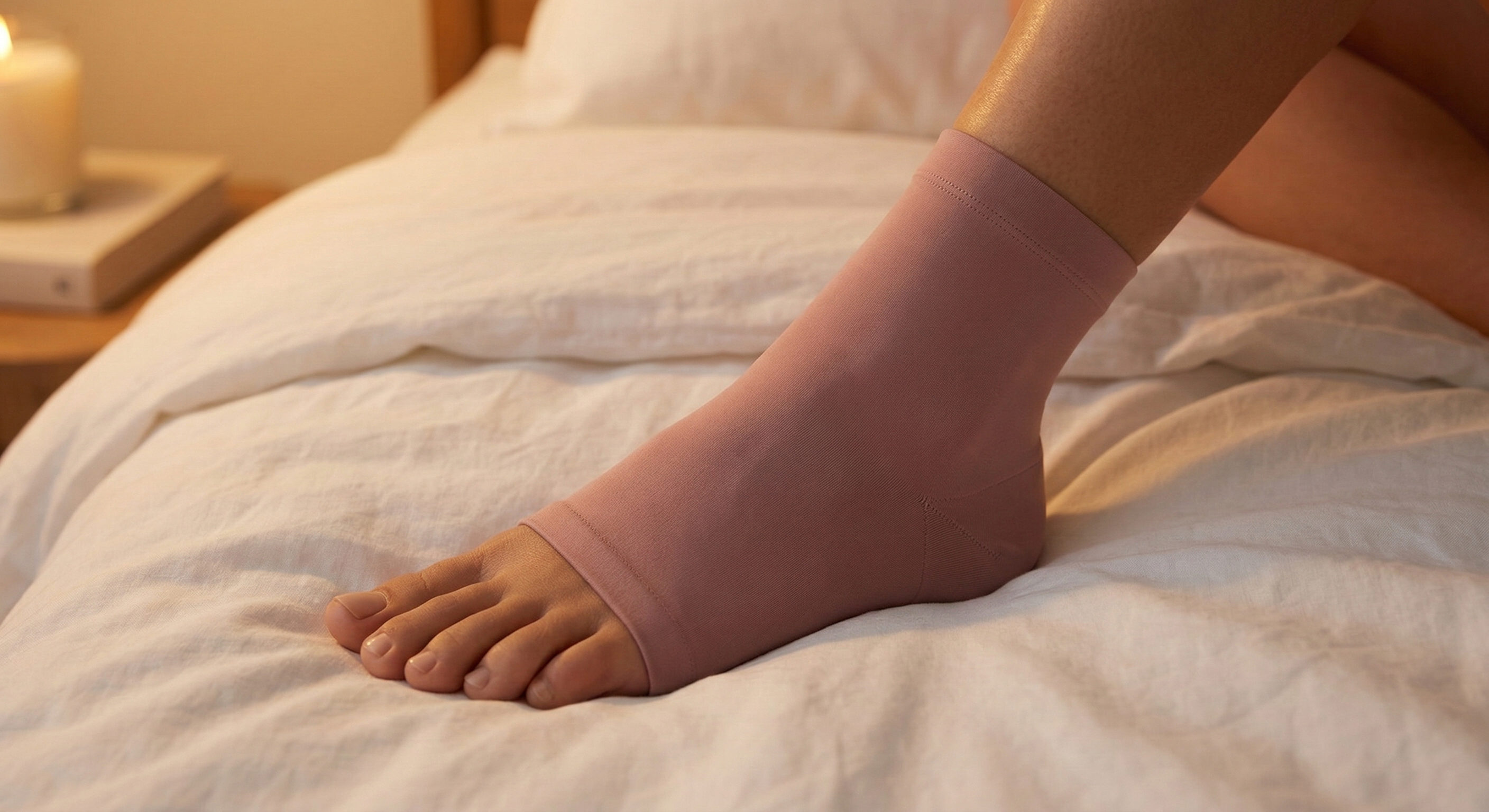
Stillr is a drug-free overnight compression sleeve, worn on both legs, designed to replicate the targeted-pressure mechanism behind the strongest non-drug evidence for Restless Legs Syndrome. It is unisex, sized for adult feet, and currently pre-launch in Australia. Reserve your pair on the founders’ list at stillr.com.au, where current pricing and sizing are listed.
Stillr is pre-launch in Australia and not yet available for supply, so no price is published. You can reserve a pair on the founders’ list.
Stillr is not a medication, not a cure, not a treatment for any disease. It is not a medicine and not a cure.
If “drug-free, on my own terms” is the version of this you want, join the founders’ list at stillr.com.au. We will tell you the moment your size opens.