Do compression socks help restless legs?
Plenty of people get real relief from compression socks, and that is worth saying plainly. What they are built for is circulation: steady graduated pressure, firmest at the ankle, helping blood travel back up the leg while you are standing or sitting through the day. Aching, swelling and heavy legs are what they handle best.
The evidence picture is thinner than the shelf space suggests. One randomised trial has tested graduated stockings in Restless Legs, and it was run in pregnancy, with the stockings worn through the day. Outside that single population, nobody has measured whether socks help.
Worth knowing what else has been tested: the stronger compression research used pneumatic devices and targeted foot compression. Neither of those is a sock you pull on in the morning.
What that means on a bad night is that a day sock is solving an adjacent problem. If your legs ache and swell by evening, a sock earns its place in the drawer.
If the trouble is the crawling, have-to-move feeling at 2am, you are asking a circulation garment to do a job it was never designed for. Our guide to whether compression helps Restless Legs goes deeper on why the two come apart.
Can you sleep in compression socks?
Most people are told not to, which is the main reason a sock cannot be your overnight answer. NHS patient guidance from Dorset County Hospital is to put a compression garment on in the morning and, for most people, take it off at bedtime. A garment you remove at night cannot work when your legs are worst.
The reasoning is about what graduated pressure is for. Lying down already does the work a day sock does standing up, because your legs are level with your heart and blood is no longer fighting gravity. Holding that pressure through the night adds little, which is why the advice sends socks to the laundry basket at bedtime.
If your GP or nurse has told you something different for your situation, follow them, not a blog.
Here is the telling part: the one randomised trial of stockings in Restless Legs followed exactly that pattern. Kaplan and colleagues (2024) had participants put them on in the morning and take them off at bedtime for three weeks. Even the study built to test socks did not test them overnight.
Where this gets genuinely confusing is the shopping advice itself. Search for the best compression socks for Restless Legs and you will get sock retailers answering the question, often advising in the same breath that you remove them before sleep. Both halves of that are true. Together they do not add up to a solution for a night-time condition.
Stillr vs compression socks: what is actually different?
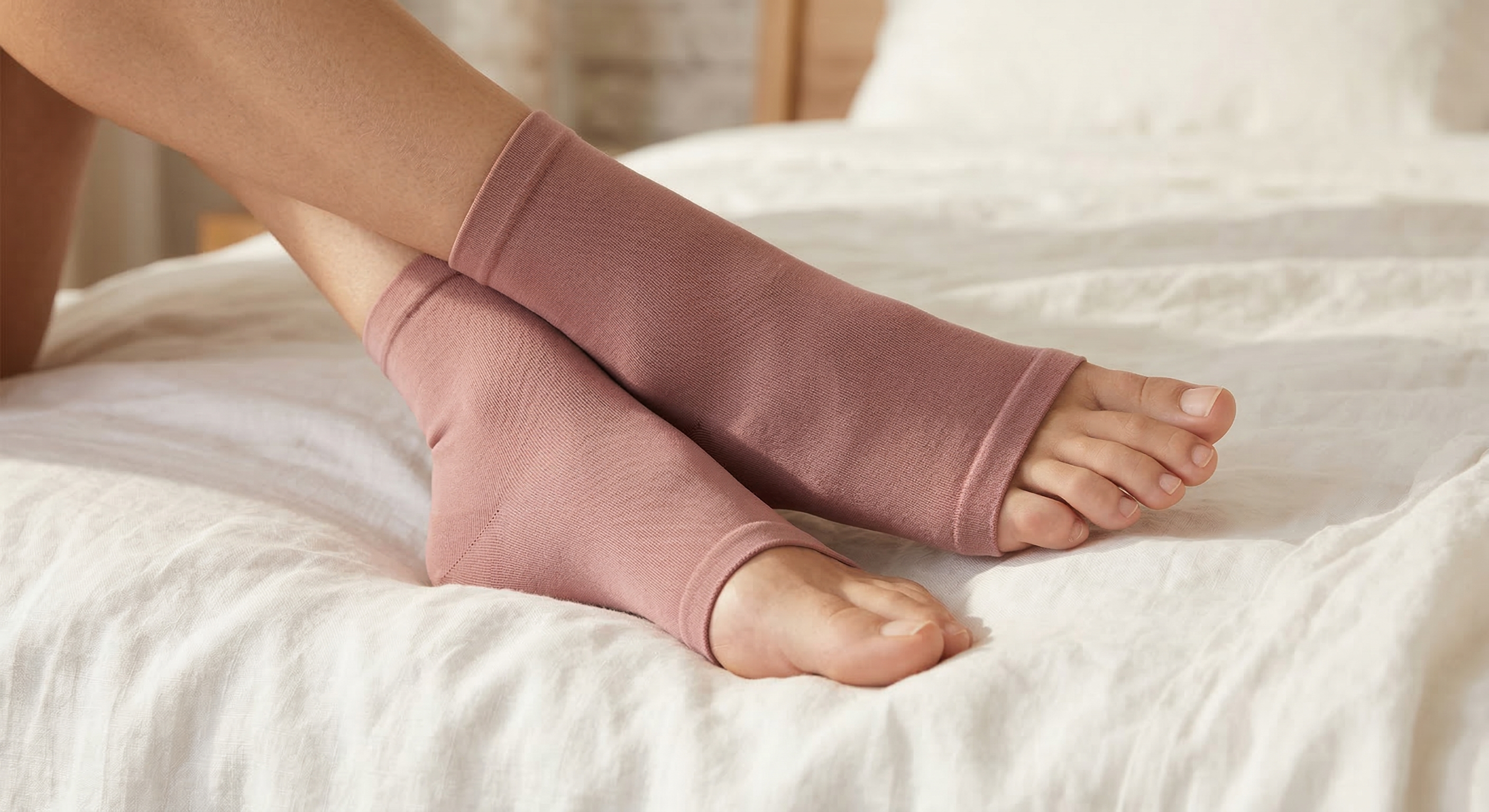
Seeing the two side by side usually settles it in about ten seconds, because they are not competing versions of the same product. One is a daytime circulation garment for the whole lower leg. The other is an overnight sleeve aimed at the foot, built to be worn through the night on both legs.
| Factor | Graduated compression socks | Stillr overnight sleeve |
|---|---|---|
| Built for | Circulation and swelling while you are upright | Restless Legs at night |
| When you wear it | Morning until bedtime | Overnight, on both legs |
| Where the pressure sits | Graduated up the leg, firmest at the ankle | Targeted compression on the foot, toes left free |
| Night-time wear | Most wearers advised to remove at bedtime | Designed to stay on all night |
| Restless Legs trial evidence | One randomised trial, in pregnancy, worn by day (Kaplan 2024) | Compression trials aimed at Restless Legs, though not on this sleeve |
| Drug-free | Yes | Yes, and no electronics or batteries |
| Origin | Varies by brand | Designed in Australia |
The honest read on that table is that a sock is not a failed sleeve, it is a different garment. If you have spent a year swapping between sock brands hoping one of them finally works overnight, the variable you have been changing is not the one that matters.
Why does an overnight sleeve work on the foot instead of the whole leg?
Getting your legs to stop, rather than getting your circulation moving, is the outcome you actually want, and that is why the pressure sits where it does. The compression research on Restless Legs points to the foot, so an overnight sleeve applies steady pressure there through a patent-pending compression structure, toes left free.
The thinking behind it is that constant, even pressure gives the restless signal a competing input, so the urge to move has something to answer to instead of building. There is nothing to swallow, nothing to plug in and no battery to remember. We lay out the whole evidence base, limitations included, in our compression evidence review.
The practical difference you notice is that you can forget you have it on. Have you tried tonic water? Yeah, most people who have worked through the sock drawer have tried that too, along with the bar of soap under the sheet and half the magnesium aisle.
The upshot is that a sleeve which stays put all night is a different kind of attempt from another pair of socks.
What the research actually shows
Wanting proof before you change anything is fair, especially after a few pairs of socks that did not help. Here is the whole of it, including what is missing, because the absence of evidence on socks is as useful to you as the evidence on compression itself.
The controlled evidence. Lettieri and Eliasson (2009, Chest) ran a prospective, randomised, double-blinded, sham-controlled trial of pneumatic compression in 35 adults with Restless Legs Syndrome, 21 using the therapeutic device and 14 using a sham.
Around a third of the active group reported complete relief of symptoms, against none on the sham. Symptom severity fell from 14.1 to 8.4 on the IRLS scale, a 40 per cent reduction, at p=0.006.
The foot-targeted evidence. Kuhn et al. (2016, Journal of the American Osteopathic Association) followed 30 adults with moderate-to-severe primary Restless Legs Syndrome using targeted foot compression over eight weeks. Participants recorded a 90 per cent improvement on the Clinical Global Impression scale, against the 63 per cent published for the drug ropinirole.
That study had no control group, so the drug figure came from earlier separate trials rather than a comparison run alongside it.
The sock evidence, such as it is. Kaplan, Baser and Ozgun (2024, Revista da Associacao Medica Brasileira) ran a randomised, placebo-controlled trial of graduated below-knee stockings at 23 to 32 mmHg in 63 pregnant women with Restless Legs. Severity scores finished lower than placebo at three weeks, at p under 0.05.
Two things limit how far that carries. The population was pregnancy-related Restless Legs, which often settles after birth, and the stockings were worn by day, not overnight. It is real evidence for daytime stockings in pregnancy, not for wearing socks to bed.
What is missing, and it matters. None of these trials tested Stillr, and none tested a graduated sock worn overnight. The sock evidence that exists is daytime wear in pregnancy; the overnight evidence is pneumatic and foot-targeted.
All three trials were small, and larger studies would strengthen every claim here. That is exactly why we publish the limitations rather than the highlights.
Which should I try first for restless legs?
Picking once is the point, so here is the call. If your legs ache, swell or feel heavy by the end of the day, start with proper graduated compression socks and wear them through the day as intended. If the crawling urge to move once you lie still is the problem, a day sock will not reach it.
Working out which camp you are in takes one honest look back at your last bad week. Ask what actually got you out of bed at 2am: heavy, aching legs, or legs that would not stop demanding movement.
Most people living with Restless Legs Syndrome know the answer straight away, and when it is the second one, the format matters more than the brand. Our roundup of the best compression for Restless Legs covers the options across both categories.
One thing worth doing either way is talking to your GP, particularly if you have diabetes, poor circulation or nerve problems in your feet, or if you are already wearing compression on medical advice. Compression is not a medicine and not a cure, and it sits alongside your GP rather than replacing them.
What Stillr is, and isn’t
Stillr is a drug-free sleeve you wear overnight on both legs, made for people living with Restless Legs Syndrome. It applies targeted overnight compression through a patent-pending compression structure, with your toes left free, no electronics, no batteries and nothing to swallow. It is unisex, comes in two sizes, and is designed in Australia.
Stillr is pre-launch in Australia and not yet available for supply, so no price is published. You can reserve a pair on the founders’ list.
Stillr is not a medicine, not a cure, and no substitute for your GP. It is for people who would rather work on their legs than keep buying socks that come off at bedtime.
If your sock drawer has run out of answers, a sleeve built for the night is a fair next step. Drug-free, on your own terms: join the founders’ list at stillr.com.au.