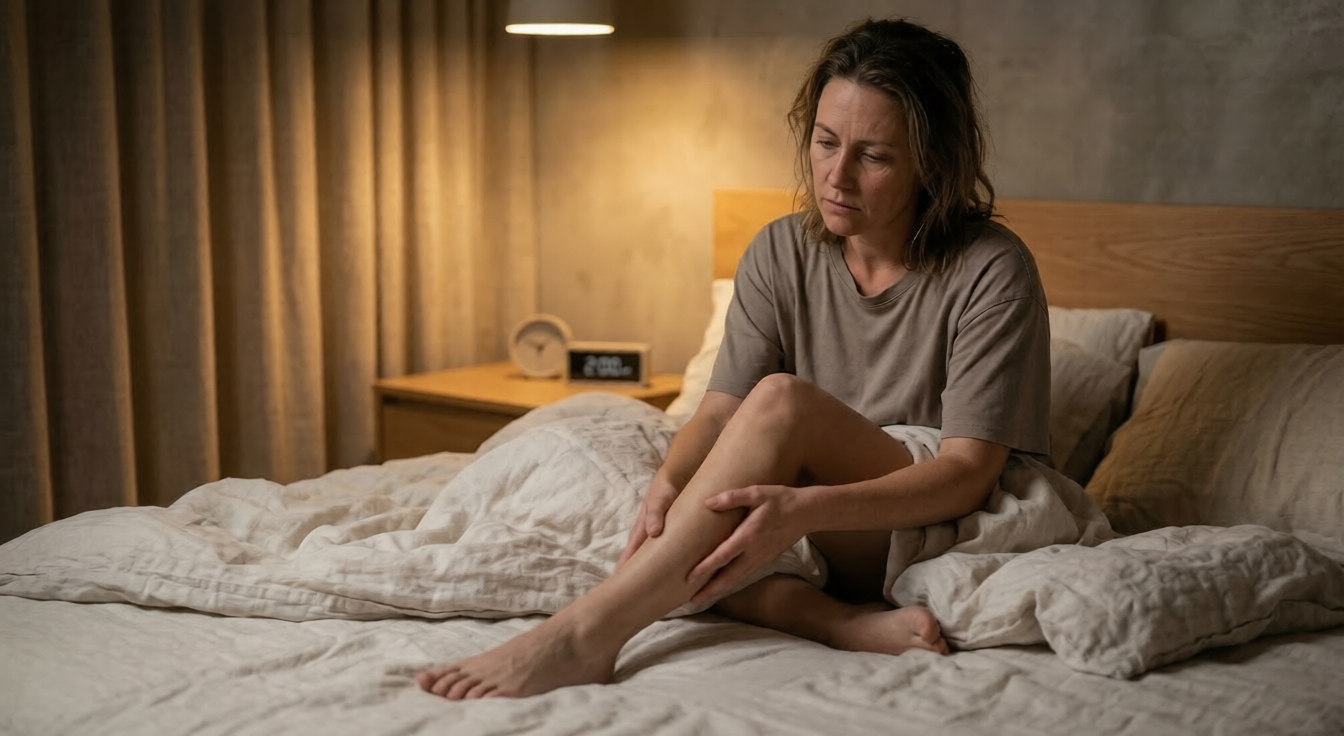
Does the Relaxis pad work for Restless Legs?
It helped more people sleep than a fake pad did, which is more than most devices here can claim. Burbank, Buchfuhrer and Kopjar (2013), in the Journal of Parkinsonism and Restless Legs Syndrome, pooled two randomised, double-blinded, sham-controlled trials in 158 adults at five clinical sites. The vibrating pad beat the sham on sleep improvement.
Wanting a device you can switch on yourself, with nothing to swallow, is completely reasonable. That was most of the appeal. You laid the pad under your legs in bed and it ran a timed vibration cycle for about half an hour. The idea was that the sensation competed with the crawling feeling.
The design detail worth knowing is how the comparison was set up. The sham was not a dead pad. It was a patient-controlled unit emitting sound or light instead of vibration, so both groups had something happening.
Whether the blinding held is a fair thing to ask of any device trial, and this one passed. Burbank (2013) reported that neither patients nor clinicians guessed their pad better than chance.
Fewer than half the people on the working device were rated as improved, and that is worth sitting with. In the clinician assessment reported in that research series, 45.0 per cent of vibrating-pad users were rated improved, against 17.2 per cent on the sham. That is a real gap and not a cure.
Can you still buy a Relaxis pad?
No, and nothing has replaced it in the same format. The FDA’s device identifier database, accessGUDID, lists the Relaxis rental packages as “Not in Commercial Distribution”, with distribution ending on 31 August 2019. Sleep Review reported in January 2021 that the company was no longer filling new prescriptions.
So if you have been reading old forum threads and hoping, that is the bit nobody updates. The listings you find now are secondhand units, overseas sellers, or pages that were written while the device was still on the market and never taken down.
There is no Australian supplier either. Relaxis was cleared in the United States only, by prescription, and it was rented rather than sold outright. We could not find any Australian stockist, past or present, which means even the secondhand route lands you with a US-voltage rental unit and nobody to service it.
That is frustrating in a specific way. You have found the one device in this category with a proper sham-controlled trial behind it, and the answer is that the market took it away. Worth knowing before you spend another hour searching.
Why did a device with real evidence stop being sold?
The reason is money, not a safety recall, which is the part most people assume. According to the company statement quoted by Sleep Review in January 2021, the decision came down to insurance coverage in the United States, not to any question about whether the pad worked.
The wording tells you how little this had to do with whether it worked. Rather than covering the device, the statement said, the Centers for Medicare and Medicaid Services “has classified Relaxis as a ‘pleasure device’”. The company’s conclusion was that “it is no longer feasible to continue offering Relaxis.”
Read that and the whole category starts to make sense. A prescription-only rental device priced for an insurance code dies the moment the insurer says no. Nothing was found wrong with it. The business model simply stopped working.
This is also why the device aisle for Restless Legs looks so thin. Options that need a prescription, a rental agreement and a reimbursement decision are fragile. Options you can buy, own and keep using are not. We go through the full field in our guide to whether there is a new cure for Restless Legs.
Relaxis vs compression for Restless Legs: what is actually different?
Whether you can sleep through the treatment is the thing that decides it for most people, so start there. Both approaches are drug-free and both work on the legs, which is why they get discussed together. They are not the same kind of product.
| Relaxis vibration pad | Overnight compression | |
|---|---|---|
| What it does | Timed vibration under the legs | Steady targeted pressure |
| When you use it | About 30 minutes, as you settle | Worn right through the night |
| Power source | Mains-powered unit | None, nothing electrical |
| How you got it | US prescription, rental only | Bought outright |
| Best evidence | 158 adults, randomised, sham-controlled | 35 adults, randomised, sham-controlled |
| Available now | No, out of distribution since 2019 | Yes |
| Covers the 2am wake-up | Only if you restart it | Yes, it is already on |
That last row is the real argument, and it is not a technicality. Restless Legs is worst at night and at rest, which is exactly when you are least willing to reach for a control panel. A timed cycle that finishes before midnight is doing part of the job.
The evidence rows deserve a fair reading too. Relaxis had the bigger trial. Compression has the trial with the harder endpoint, which we cover in our compression evidence review. Neither of those is a knockout, and anyone telling you otherwise is selling something.
What are the alternatives to the Relaxis pad in Australia?
The honest list is short, and only part of it is buyable here. Vibration specifically has no current product behind it, so the realistic options are compression, a nerve stimulation device you probably cannot get, or the drug conversation you may already have had.
If you want the strongest device evidence going, it exists, and you probably cannot get it. Buchfuhrer and colleagues (2021), in the Journal of Clinical Sleep Medicine, ran a randomised crossover trial of prescription nerve stimulation in 37 adults against a sham device.
The relief was measurably bigger than anything vibration or TENS has produced. Symptom severity fell 6.81 points on the standard scale, against 3.38 for sham. It is a prescription device, and it is not readily available in Australia.
A TENS machine is the thing people buy instead, usually by accident. It is a different mechanism, the sessions happen while you are awake and sitting up, and the one decent trial added it on top of medication rather than replacing one. Our TENS review has the detail.
Compression is the option you can actually own, and the category splits further than most people expect. Foot wraps, ordinary compression socks and overnight sleeves are three different products with three different evidence bases. Our roundup of the best compression for Restless Legs separates them, and our Restiffic review covers the foot wrap that the eight-week study used.
Weighted blankets come up constantly in the same breath as vibration pads, because both promise a sensation that distracts from the crawling. Have you tried a weighted blanket? Yeah, plenty of people have tried that too. Our weighted blanket comparison is honest about what it does and does not do.
What the research actually shows
Four studies decide this comparison, and it helps to see them next to each other rather than one at a time. Two are properly sham-controlled, one is a single-arm study, and one is the guideline that shapes what your GP will say. Here is what each can and cannot tell you.
Vibration, properly controlled. Burbank, Buchfuhrer and Kopjar (2013), in the Journal of Parkinsonism and Restless Legs Syndrome, pooled two randomised, double-blinded, sham-controlled trials in 158 adults at five sites. The vibrating pad beat a sound or light-emitting sham on sleep improvement, and blinding held. It is the best device trial here, and the device is gone.
Compression, properly controlled. Lettieri and Eliasson (2009), in Chest, ran a randomised, double-blinded, sham-controlled trial of pneumatic compression in 35 adults, 21 on the real device and 14 on sham. Symptom severity fell about 40 per cent, from 14.1 to 8.4 on the standard scale, and roughly one third reported complete relief while nobody on the sham did.
Compression over eight weeks. Kuhn et al. (2016), in the Journal of the American Osteopathic Association, followed 30 adults using targeted foot compression. Participants recorded a 90 per cent improvement on the Clinical Global Impression scale, against the 63 per cent published for ropinirole. The study had no control group, so that drug figure came from earlier trials.
What the guideline recommends. The 2024 American Academy of Sleep Medicine guideline (Winkelman et al., Journal of Clinical Sleep Medicine) puts its strong recommendations behind the alpha-2-delta medicines, including gabapentin enacarbil and pregabalin. It also recommends intravenous iron for adults with ferritin under 100 micrograms per litre, and advises against routine ongoing use of the older dopamine drugs.
The pattern is awkward and worth saying plainly. The drug-free device with the biggest trial is gone, and the drug-free approach you can still buy is the one applying pressure. That is why our compression explainer exists.
What Stillr is, and isn’t
Getting through the night without managing a device is the whole point, and that is what Stillr is. It is a drug-free compression sleeve worn overnight on both legs, with a patent-pending compression structure, no batteries and no wires. It is not a medicine, not a cure, and no substitute for your GP.
Stillr is pre-launch in Australia and not yet available for supply, so no price is published. You can reserve a pair on the founders’ list.
If you have spent an evening chasing a device that turned out to be discontinued, what you are actually after is a night you do not have to manage. Something already on when the legs start, rather than something to plug in, time and restart. You can reserve your pair and join the founders’ list at stillr.com.au.